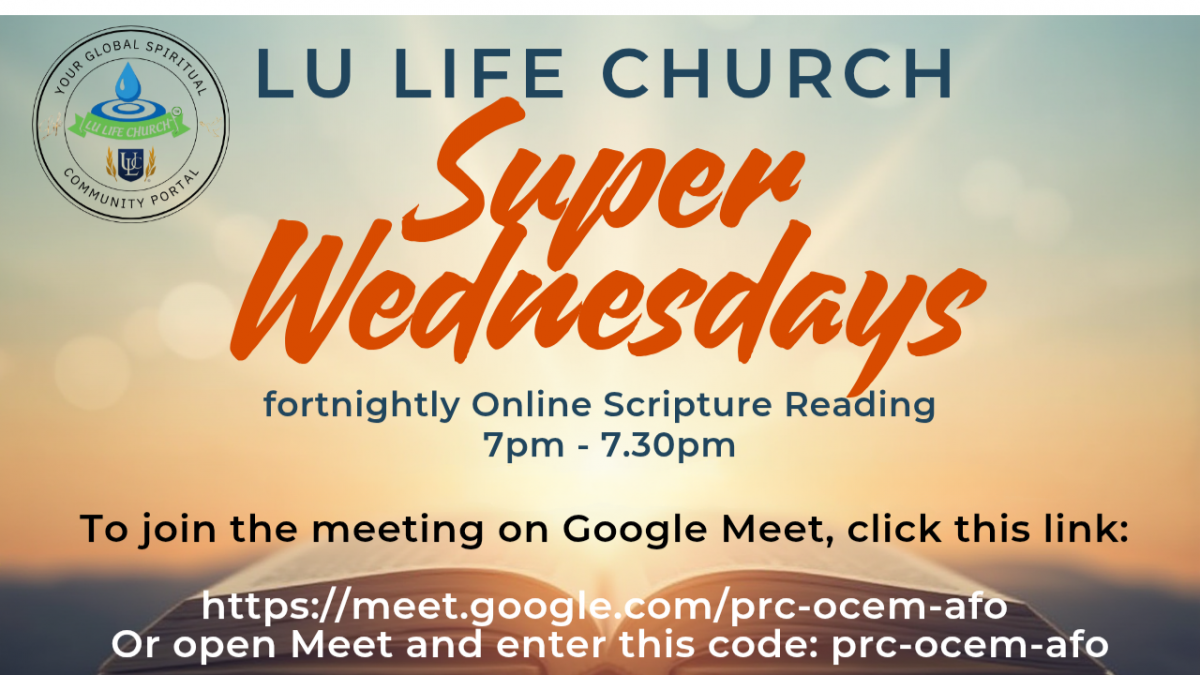
Our Super Wednesdays are LIVE fortnightly 7 pm to 7.30 pm
(Next Reading Wed 25th March)
 To join a Live Scripture Reading/Study please use the GoogleMeet link below
Google meet Link:  HERE
HERE
NOTES from 11th March 2026
2026 LU LIFE CHURCH HOPE & JUSTICE A Year THROUGH THE SCRPTURES Topic: Humanity’s Rebellion, Systemic Exploitations, a Promise, and Blessing
Our studies so far: Gen 1 v 27 Foundation of Human Identity , Role of Stewardship. Genesis 3 v 1- 14 & Romans 5 v 12-14. Creation and the Foundation of Justice & The Redemption Emancipation Story. Genesis 3 v 14 -24 Consequence, Curse, Pain and Expulsion
And hence we find the reign of rebellion and exploitations in individual human hearts, spreading through family bloodline, cattle, affecting food, vegetation, ocean and atmosphere, evolving into systemic exploitations with time.
With humanity’s expulsion meant they were now living in the shadow of death, away from access point both to the reminder of the Word of Life as well as Access to the Tree of Life, humanity began to forget their maker and the principles for life, began the downward spiral into rebellion. What did this look like?
We know the story their eyes were open. We can see the result of this- they began to try to hide from God. What does this mean for you? Answer: The sense of Separation.
In togetherness there is harmony, unity, sharing, transparency, openness in a unified space of oneness. In separation there is hiding, control. Disadvantage, competition, shame, blame, exclusion and disunity.
Separation affects the good working of everything. Difference make a difference and changes everything where trust, honestly, and fellowship is concerned. In such a state it is quite easy to exploit each other. One take advantage of the other. Position matters over being. And not just over each other but how they manage the animals. This quickly affects the oceans, the atmosphere, and plants. The whole planet soon becomes instead of a place of security and safety one of fears, terrors, insecurities and sufferings, leading to economic exploitations and social unrests.
Prior to the misidentify there was complete oneness, order, and harmony. Misidentify let to rebellion and disobedience, which led to expulsion. Expulsion as we are seeing today led to the humanity’s story of exploitation. Gross enslavement of mind, bodies, and ego. These exploitations are all a part of a world and people separated from God and true alikeness as was intended.
But here is the good news for our Justice and Hope – God, Maker of all, LIFE, has not abandoned it’s alikeness.
Genesis chapter 12 vs 1-3 and chapter 18 vs1 7-19
In this study today we’ll see that Abraham and his descendants were raised up and blessed to be a blessing to humanity, designating to them again the command and opportunity to do what is just (meaning good, fair and equal) and right.
By choosing Abraham and his descendants humanity and the world once again have the chance of full restoration, this is where hope comes in. And through the Abrahamic Blessing the identity be restored once again, the peoples of the world would be saved.
The Divine Call Genesis chapter 12 vs 1 to 3;
12v1 It does not tell in the texts why Abraham was chosen rather than another person or family. The Lord had said to Abram, “Go from your country, your people and your father’s household to the land I will show you.
12 V2 But what the texts does tell is that Abraham’s calling and being chosen and blessed was to restore the original mandate for humanity, and everything else to be again in balance and harmony with the creator.
“I will make you into a great nation, and I will bless you; I will make your name great, and you will be a blessing.
12 V3 “ I will bless those who bless you, and whoever curses you, they will be cursed so that all people will be blessed through you.
This last statement shows LIFE’s inclusive turning point for humanity’s future and the world. This means anyone born after this point, including you and me.
Let us look at the process:-
12 v 1 first Abraham was told that he had to leave the land he had call his to somewhere that God would choose for him. Here was the juncture for obedience in humanity to be restored. Disobedience to the first covenant brought corruption.
12 v 2 Where identity was lost there was a promise to grant a new identity. The Blessings changed Abraham’s destiny.
12 V 3 The ultimate goal is that “all the families of the earth shall be blessed” through him, turning Abraham into a conduit of divine blessing for the world.
This verse also signifies the promise of protection as we read in Romans 8 v31 “If God is for us, who can be against us?” and Numbers 23 v 19-20: Shows that God’s blessings are permanent and cannot be removed reversed by anyone. The Blessing removed the curse.
Restoration promised through Obedience: The blessing is subject to the obedience. Obedience is the covenant for humanity’s restoration. Abraham’s obedience and his descendants obedience to the covenant to walk in the blessing as one chosen was the creators vision to restore all humanity, all families would come through this family and earth would be blessed again.
Genesis chapter 18 vs 17-19
V 17 Then the Lord said, “Shall I hide from Abraham what I am about to do?
V 18 Abraham will surely become a great and powerful nation, and all nations on earth will be blessed through him.**
V 19 For I have chosen him, so that he will direct his children and his household after him to keep the way of the Lord by doing what is good, right and just, so that the Lord will bring about for Abraham what he has promised him.
NOTES from 25th February 2026
25th Feb LU LIFE CHURCH ‘HOPE & JUSTICE’ A Year THROUGH THE SCRPTURES. Topic Consequence Curse Pain and Expulsion
Our studies so far: Genesis 1 v 27; Genesis 3 v 1- 14, Romans 5 v12-14. By granting humanity access to the Tree of Life again humanity have opportunity, possibly and potential to Hope. Christ represents the Tree of Life. And Christ in man is the hope of Glory.
The Glory is eternal life which is continually maintained by having access to and eating of The Tree of Life. By partaking of the Tree of Life humanity awareness is once again open to God, so that they choose good, right, and pleasant. Adam and Eve opted for Treason thus by passing their true identity . And what was their true identity? Their true identity is their image and alikeness to their Creator. In the Redemption Emancipation Story humanity once again gained access to favour, and the opportunity to restore humanity’s identify, authority, and dominion.
The Redemption Emancipation Story is Humanity’s reason for Hope and Justice.
Following the disobedience to follow instructions to do what is right they chose to do what looked good instead. Can you note the difference? There is definitely a rule to doing what is right and doing what feels good or look good. I think most persons miss this in the Genesis story . They never really realise what5 took place on that fatal day which led Eve and her husband Adam to eat of the tree of the knowledge of God and Evil which has affected humanity’s behaviours and freedoms to this day. And what was that? Let’s revert to the instance in question Genesis 3 v 6
Here we go, see if you recognise any inherent trait right there?
V6 When the woman saw that the tree was not only good for food but ‘pleasing to the eye’ or in our translation ‘good to look at’ or ‘pleasant’ also desirable for gaining wisdom or a nice way of get wisdom, looks like that person know a lot about something that sounds good and look good but is it good?
From our text here we see why Eve was hoodwinked, she was caught off guard by too many variable…good to look at pleasant, she would be wiser about stuff, but it was not right. Now here is the catch- ‘eyes will be open and you will be like God, knowing good and evil and I see this same dislocation happening up to this day folk hoodwinked mistaking alikeness to likeness. Likeness is separation alikeness is alignment and oneness. This is Lucifers greatest trick and his downfall, he will use it forever.
Having abandoned their freedoms, Adam and Eve and their generation brought forth a system of many exploitations human beings amongst themselves, socially and economically, all due to the sense of separation from their creator.
I want you to really take time out now to imagine yourselves as the first fruits of your maker. Then imagine that something comes up and tells you that your maker is keeping something from you that would make you better than you are. But what you have to bear in mind is that your maker had told you at the get go that you are given authority to represent the very creator, and to have dominion over every ting that was made on the earth, also you were privy to the tree that would ensure that you have eternal youth.
What would you do different? And have you ever found yourself in a similar situation? What did you choose to do? And what could you have done differently? If anything?
Even though it tells the story that Adam and Eve failed, their maker, the creator, had no intention of abandoning what was created and fashioned according to the image and alikenesss.
Genesis 3:14 -24 Consequence, Curse, Pain and Expulsion
From verse 14 we read about the couple getting indebted with a set of consequences for their failure or bad choice.
The consequence (unpleasant result or unwelcome effect) led to a charge and a sentence. The consequence was a curse. The accuser and tempter, the serpent was also cursed, as was the earth, and everything on it. Hence we pray when we eat, when we go out and when we come in. The reason we pray continually. Prayers are humanity’s way of living safe in an earth that was once cursed. If all humanity was to turn again to do what is good, and right, and pleasant then the earth would again become replenished and blessed.
The Serpent v 14–15: The serpent is cursed above all livestock, condemned to crawl on its belly and eat dust. God commanded “enmity” (hostility) between the serpent and the woman, and their offspring. He decreed that the woman’s children would crush the serpent’s head, and that the serpent would strikes the man’s heel.
The Woman v 16: The woman’s curse was to have severe pain in when giving birth and a sort of half broken relationship where the woman’s desire is for her husband, but he asserts rules over her. Now remember here that this was under the curse. When we assume full alignment and alikeness again the curse is no longer viable and Jesus assumed this position on behalf of the whole human race so that all who believe in their heritage is automatically removed from this curse.
The Man and The Ground v. 17–19 the disobedience of the man caused the earth to receive a likewise consequence and curse. The curse on the earth was that it would now produce thorns and thistles.
And the curse for the man was to toil, painful labour that caused him to sweat from which he would reap food as a result of this painful labour until the day he dies and return to the ground. Here we see the curse of immortality as consequence of not feeding from the tree of life in the garden of life.
Expulsion from Eden and the tree of Life v 20–24: In these verses we see God putting them out of Eden. God puts Cherubim and a flaming sword to guard the way to the Tree of Life which not only prevent them from eating from it but from accessing their heritage- eternal life. The man, woman, serpent and everything would no longer live forever in the fallen state. ‘I’ is a state in the intention and will of God, ‘me’ is a position of that state. Eve foolishly forfeited her state for a position. In her true state Eve was already in the promised position for which she traded her obedience and trust.
Who do you trust? Be aware at all times. The serpent does care about our age or whether you have enough money or pretty or ugly, or weak and afraid. No it seeks to cause you to forget who and what your purpose is. And your reason for being.
And so we find that from that time there began a reign of systemic and exploitations. Man exploiting (taking advantage of) each other, animals, the ocean, the atmosphere and the planets. These exploitations are all a part of a world and people separated from God and true alikeness as was intended. are part But here is the true magic or miracle or good news of Justice and Hope – God, Maker of all, LIFE has not abandoned his alikeness. In our next studies we’ll look at how he raised up and blessed Abraham and his descendants to be a blessing to humanity, designating to them again the command and opportunity to do what is just (fair and equal) and right.
NOTES from 11th February 2026
2026 LU LIFE CHURCH HOPE & JUSTICE A Year THROUGH THE SCRPTURES Topic: Redemption Emancipation Story
How many Books are there in the Bible? There are 66 Books. 39 Old testament and 27 New Testament.
What do you call a person who has been liberated from the rule, enslavement, or dominion of sin (separation, unconsciousness) and the finality of death? The Super Wednesday Scripture Readings will encourage and bring hope with a wonderful positive playout of the Redemption Emancipation Story; you and I, and all humanity’s story, so far.
A recap from our last class: we looked at the Role of Stewardship: The dominion mentioned is not for exploitation but one of stewardship, of caring for the earth on behalf of its Creator. We also looked at the Foundation of Human Identity: The Scripture verses we looked at for this is genesis 1 v 27. This passage is foundational for Christian theology regarding the worth of human life.
However it is obvious that something went wrong between that setting (intentional design – Gen1:27) to where we are today. Like explorers our further studies will retrace the Genesis story from our perspective of where we are in life today and how are retaining or not retaining the role of dominion and upholding our human identity as was originally intended.
For this we will advance to the 3rd Chapter of Genesis reading from verse1-24. Here it tells how the first Adam disobeyed God, and how sin, hiding, separation and death entered the story of our world. The story thus far is not so much about Adam’s failure to obey commands and instructions, but the transfer of humanity’s authority, loss of identity, and implication of what this meant for humanity to this day.
The reading it describes the dominating nature of sin or separation from God, the original blueprint for humanity. However humans behaviours became de-humanising behaviours, both how they treated themselves and how they treated each other, and we still see these behaviours in our societies today, and engrained with our systems.
These play out as social and economic exploitations and injustices. Such emerge from a segregated world view of Heaven and earth, or of God and humanity. But LIFE does not and will not abandon what was created in image-and alikeness of Itself as we will see in today’s reading. (Genesis 3:1-24 and Romans 5:12-14).
Genesis 3:1-24 Speaks about the failure as the serpent tempts Eve to eat forbidden fruit, she gives it to Adam, they disobey God, realize their nakedness, hide, and are then judged and expelled from the Garden of Eden with consequences including painful labour, hard toil, mortality, and expulsion to guard the Tree of Life. These sets up a stage in the story for humanity’s struggles and sense of separation from God.
The Temptation & Disobedience Verses 1-7
- Serpent’s Deception: The cunning serpent questions God’s command, asking if they truly can’t eat from any tree, then denies God’s warning, claiming they won’t die but become like God, knowing good and evil.
- The Act: Eve sees the fruit is desirable, takes some, eats, and gives it to her partner Adam, who also eats the forbidden fruit.
- Awareness: Their eyes are opened; they realize they are naked and sew leaves together for coverings.
The Fall/failure: Genesis 3 v1 24
1Now the serpent was craftier than any of the wild animals the Lord God had made. He said to the woman, “Did God really say, ‘You must not eat from any tree in the garden’”
2 The woman said to the serpent, “We may eat fruit from the trees in the garden, 3 but God did say, ‘You must not eat fruit from the tree that is in the middle of the garden, and you must not touch it, or you will die.’ ”
4 “You will not certainly die,” the serpent said to the woman. 5 “For God knows that when you eat from it your eyes will be opened, and you will be like God, knowing good and evil.”
6 When the woman saw that the fruit of the tree was good for food and pleasing to the eye, and also desirable for gaining wisdom, she took some and ate it. She also gave some to her husband, who was with her, and he ate it. 7 Then the eyes of both of them were opened, and they realized they were naked; so they sewed fig leaves together and made coverings for themselves.
The tree of good and evil was planted as a reminder, as soon as they ate of it they did the opposite, they forgot. Humanity fell into this state of forgetting who (purpose) and what (reason) they are.
Romans 5:12 -14 explains that sin and death entered the world through one man, Adam, affecting all humanity because all are considered to have sinned in him. Paul highlights that death ruled even before the Mosaic Law, establishing Adam as a representative “type” of Christ, where one man’s action brought universal condemnation.
Even as the Tree of Good and Evil was intended as a reminder for Adam and Eve to be mindful of who and what they are. And what is that? They were intended to be eternal beings having access to the tree of life. Romans 5:12-14 expands the story to shows that humanity has once again granted access to eternal life, through Christ. Christ represents the Tree of Life.
And by granting humanity access to the Tree of Life again humanity have the opportunity and possibly and potential to Hope. Fuller understanding of this is this – eternal life is maintained by having access to and eating of The Tree of Life. By partaking of the Tree of Life humanity awareness is open to God, they choose good, right, and pleasant. Adam and Eve opted for Treason to bypass their identity which was their alikeness to their Creator. In the Redemption Emancipation Story humanity have access to favour, and opportunity to restore identify, authority, and dominion.
The Redemption Emancipation Story is Humanity’s reason for Hope and Justice.
NOTES from 28th January 2026
2026 LU LIFE CHURCH HOPE & JUSTICE A Year THROUGH THE SCRPTURES Topic: Creation and the Foundation of Justice; Foundation of Human Identity and the Role of Stewardship
The Bible consistently weaves the themes of social justice and hope from Genesis to Revelation, rooting them in God’s own character and his redemptive plan for creation.
Genesis: Creation and the Foundation of Justice
The foundation of social justice begins in Genesis with the declaration that all human beings are created in the image of God
Today’s Scripture Reading Genesis 1:27
Then God said, “Let Us make man in Our image, according to Our alikeness; let them have dominion/authority over the fish of the sea, over the birds of the air, and over the cattle, over all the earth and over every creeping thing that creeps on the earth.” So God created man in His own image; in the image of God He created him; male and female He created them.
This establishes the intrinsic worth and equal dignity of every person, regardless of social status, race, or gender, a revolutionary idea in the ancient world. The original mandate includes human responsibility for caring for the earth (stewardship) and for one another, setting the stage for a society of love and belonging.
The biblical narrative starts with God creating human beings as his image-bearers (Genesis 1:26-27). Their role is to be his vice-regents to rule over and care for his good creation.
Genesis 1:26-27 records the creation of humanity in God’s image and likeness, establishing a unique identity, value, and purpose for both male and female. God grants humans stewardship or “dominion” over the earth, including fish, birds, livestock, and wild animals. This passage defines humanity’s role as God’s representatives.
Key Points to note
- Divine Image: Humans are uniquely created in the “image” and “alikeness” of God.
- Shared Dominion: Both men and women are given authority to rule over the earth’s creatures.
- Male and Female: Humanity is intentionally created as male and female.
- Purpose: These verses shows us that every human possesses inherent dignity, value, and a specific, noble purpose.
- Role of Stewardship: The dominion mentioned in these verses are not for exploitation but stewardship, caring for the earth on behalf of the Creator.
- Foundation of Human Identity: This passage is foundational for Christian theology regarding the worth of human life.